One room, up to 200 sq ft, deep-cleaned by our senior crew — corner spots, stair edges and deodorizing thrown in free. No contract, no membership, no obligation to book anything else. We'll explain further down exactly why we lose money on this.
★★★★★
4.9 rating · 631 reviews across the Tri-County area
Rather just talk to a person? Call (555) 016-2219 and say "the $19 room."
One room, up to 200 sq ft · extras included free
Takes 30 seconds. We'll call back within one business day to pick a time.
Let's not pretend. A senior two-person crew, a truck-mounted machine, and forty minutes of real work do not cost $19. You already know that — it's probably why an offer like this makes you a little suspicious. Good. You should be. So here's the whole play, out loud:
The hardest sale in the world is the first one. We'd rather prove it than pitch it.
You've never used us, so anything we say about our work is just marketing. But the moment you've paid us — even nineteen dollars — everything changes. We're not a stranger with a pitch anymore; we're your carpet company, standing in your hallway, having already shown you exactly what we do. If we're great, you'll probably have us do the rest, this year or next. If we're not, you got the cheapest deep clean in the Tri-County area and we deserved to lose the money.
That's the whole strategy. No fine print, no membership you have to cancel, no bait-and-switch on the price. We're buying the chance to earn a customer, and we're paying for it with the first room.
Marisa D. — owner, FreshStart Carpet Care
Cleaning Maple Grove & the Tri-County area since 2011
We start about $42 underwater before we ring your doorbell. A new customer costs more than that in advertising anyway — and an ad can't clean a carpet. (Illustrative figures.)
First come, first served · 13 of July's 40 slots left
The first room is our audition, so it gets the whole performance — the senior crew, the truck-mounted machine, and every extra we'd normally line-item. Nothing about it is the "lite" version.
Why overdo it? Because a merely fine first impression earns us nothing. The only version of this bet that pays off is the one where you stand in the doorway and say "oh — I didn't know it could look like that."
Most companies hide this part. We'd rather you walk in knowing the script.
Because it is. Pick the room you'd least want a guest to see. Our crew deep-cleans it — extras included — in about 40 minutes, and you inspect it before we pack up a single hose.
~40 minutesIf you want it, we'll price the rest of the house on the spot: a flat per-room figure, on paper, no "today only" games. That's why the form asked how many rooms — we arrive ready.
Flat per-room pricing"No thanks" ends the conversation, full stop. No follow-up calls, no guilt, no strings. You keep the cleanest room in the house for $19, and the quote is good for 90 days if you change your mind.
No strings. Really.This is the version of "someday" that costs $19 and happens this week.
Or call (555) 016-2219 — Mon–Sat, real humans
Years of foot traffic settle in so gradually you stop seeing them. Then one room comes back to its actual color — and suddenly the hallway looks wrong.
THE ONE YOU'RE USED TO
THE $19 ROOM
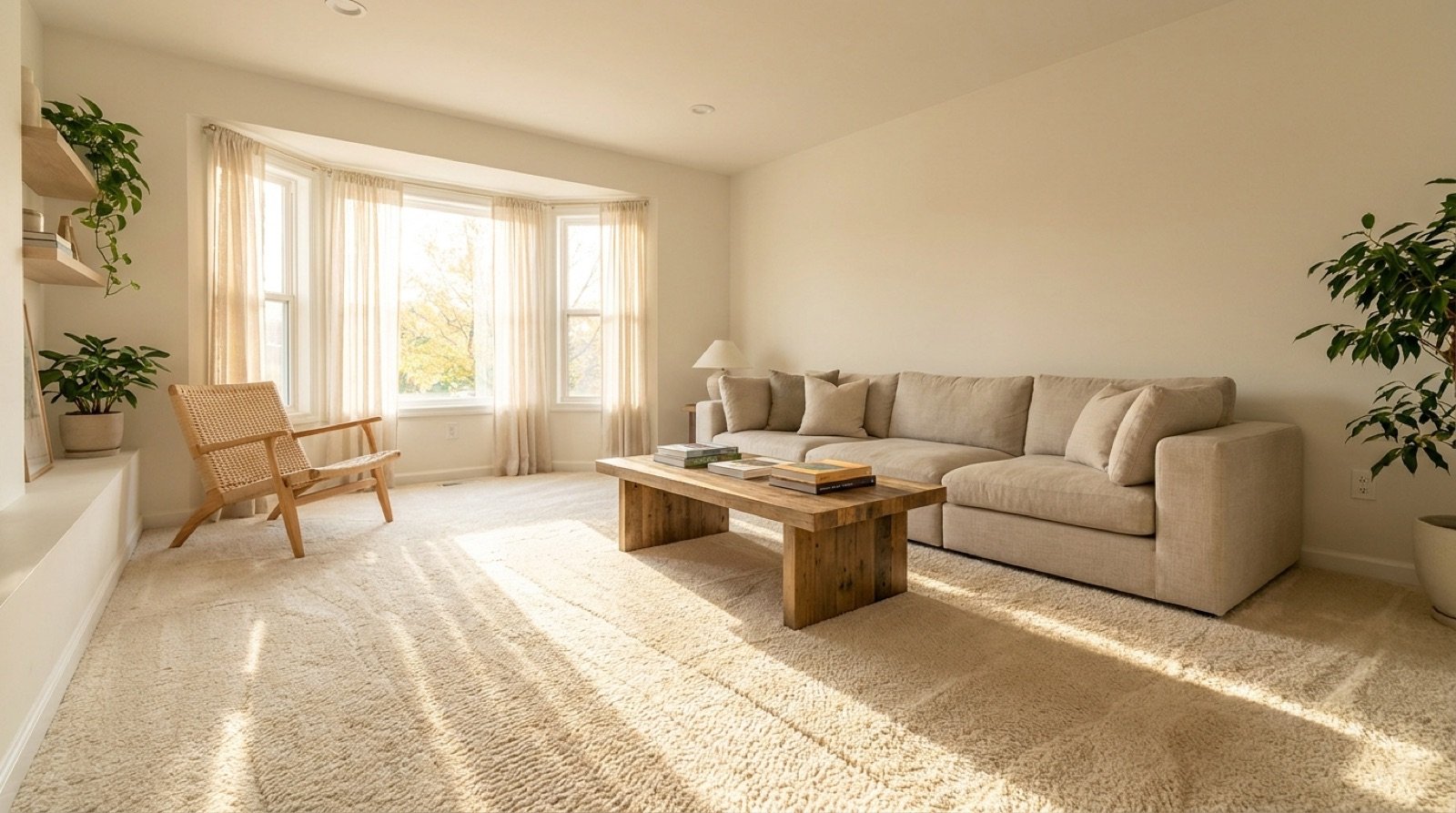
Styled illustration of a typical first-room result — not a paired photo of a single job.
One room, extras free, no obligation to book the rest.
"I booked the $19 room fully expecting a sales ambush. Instead the tech cleaned my living room, showed me the difference at the edges, handed me a written quote for the other four rooms, and left. I sat with it for two days, did the math, and called them back myself. The whole house looks brand new."
Renee W.
Homeowner · Maple Grove — booked the whole house after
"Here's the real test: I said no to the quote. Money was tight that month and I only wanted the one room done before my in-laws visited. Nobody blinked, nobody called me five times after. Eight months later, when I was ready, they're who I called — because of how they handled the no."
Tom G.
Homeowner · Cedar Falls — said no, came back anyway
One room. Nineteen dollars. Every extra thrown in, and a written quote you're free to ignore. If it isn't the cleanest carpet you've ever seen, don't book the rest — that's the whole deal.
13 of July's 40 first-room slots left · first come, first served
This is the canonical tripwire page — a tiny, irresistible first purchase built to turn a stranger into a customer. Here's my thinking, element by element.
The person landing here has been meaning to get the carpets done for about a year. It's never urgent — the carpet will still be dingy tomorrow — so "someday" always wins. A $200 whole-house quote keeps it in someday territory; a $19 single room is small enough to decide right now, on the phone, in the kitchen. The offer's real job isn't discounting — it's ending procrastination.
The hook is the deal: $19 against a struck-through $89 is a money story you understand before you read a word. But money only opens the door — the payoff being purchased is comfort: a home that looks and smells the way it did when the carpet was new. I lead with the number and let the imagery and copy sell the feeling. Deal gets the click; comfort gets the booking.
Everyone knows the cheap-clean trick: a $19 door opener, then a technician who won't leave until you've bought the deluxe package. So the headline hands the visitor the exit — "don't book the rest" — and the honesty block says the quiet part out loud: yes, we hope you book more; no, we won't push. You can't dissolve this objection by avoiding it. You dissolve it by confessing to it.
The moment money changes hands — even $19 — the relationship flips: no longer salesman and prospect, but advisor and client. That flip is worth losing money on, because the first sale is the hardest one there will ever be, and he who acquires the most customers wins. One rule keeps it honest: always overdeliver on the tripwire. A first purchase that disappoints is money burned twice.
The price lockup and the form share one coupon-shaped card, above the fold — the offer and the way to claim it are a single object. It asks only what anyone knows off the top of their head: name, phone, ZIP, and a one-tap room bracket. That bracket isn't nosy; it lets the crew arrive with the follow-on quote already sketched, which is the whole business model in one radio button.
$19 alone is just a number; $19 beside a struck-through $89 is a 78% steal you can verify at a glance. The anchor also quietly teaches the visitor what the other rooms will cost later — no sticker shock when the quote comes, because the real rate was on the page from the first second. An anchor that hides the full price is a trap; one that shows it is a preview.
The centerpiece. The company explains its own funnel — we lose about $42 per first room, on purpose, because proving beats pitching — complete with a cost receipt. Suspicion is the tripwire's natural enemy ("what's the catch?"), and you can't out-design suspicion. You can only out-honest it. Saying the quiet part out loud is disarming precisely because nobody expects it.
Corner spots, stair edges, deodorizing — extras a competitor would line-item, thrown in free and itemized so the generosity is visible. If the first impression is the product, it has to be excessive: the goal is the customer doing the mental math and concluding they got away with something. That feeling, not the clean carpet, is what gets talked about at the neighbor's fence.
Status proof — 4.9 stars, 631 reviews — sits beside the headline, because a deep discount without credibility reads as desperation. Personal proof does the finer work: one customer who booked the whole house, and one who said no, kept the $19 clean, and came back eight months later. That second story is the most valuable testimonial on the page — it proves the no-strings promise with a witness.
Forty first-room slots a month is real arithmetic — a company can only absorb so many loss-making visits — so the slot counter is a fact, not a prop. For a buyer whose default is "someday," a genuine monthly cap supplies the missing deadline. No fake countdown clocks anywhere: this page's entire persuasion strategy is honesty, and one fake device would poison all of it.
The ask returns roughly every screen-height — after the honesty block, the steps, the result cards, the reviews — with the phone number alongside for the talkers. The button copy rotates through the offer ("Get my first room for $19"), the concession ("Fair enough — I'll take the $19 room"), and the challenge ("See it on your own carpet"), because different readers say yes to different framings at different depths of the page.

Including the uncomfortable ones — answered the same way the page sells: honestly.
There's no catch, but there is a strategy, and the page says it out loud: the company loses money on the $19 room on purpose. It's their cheapest way to earn a new customer — cheaper than ads, and far more convincing. You get a genuinely underpriced clean; they get a chance to show you their work. If you never book another room, they simply lost that bet — and they knew the odds when they made it.
No — and not just out of politeness. Pressure would torch the whole point of losing money on the first room. While the room dries you get one flat per-room quote in writing, and then the technician leaves. If the answer is no, the $19 clean is still yours, no follow-up calls. A tripwire offer only works if the "no" is genuinely free to say — the clean room is the pitch, not the person standing in your hallway.
No. Honestly, no — labor, truck, fuel and solution run around $61 per first-room visit, so the company starts roughly $42 underwater before ringing the doorbell. That's fine, because the hardest sale in the world is the first one. A new customer costs more than that in advertising anyway, and an ad can't prove anything. A spotless room can. They'd rather spend the money proving it than pitching it.
Any carpeted room up to about 200 square feet — living room, bedroom, den, home office. Pick the one you'd be most embarrassed to show a guest; that's the point of the offer. Stairs are priced separately as their own item, but the technician will do the top and bottom stair edges free where they meet the $19 room, along with corner spots and deodorizing.
It converts the traffic the company already has — a page doesn't create demand, it stops you leaking the demand you're already paying for. The tripwire is what does the heavy lifting: it turns a stranger comparing five quote forms into a paying customer today, because $19 is an easier yes than $200. Once someone has been a customer once, even a tiny one, they're dramatically more likely to buy again. He who acquires the most customers wins.
Because making someone scroll to reach you is a tax on your own lead flow. The person who lands here has been meaning to deal with the carpets for a year — the $19 offer finally makes it a today decision, and the form has to be right there in that moment. Every screen-height between the offer and the form loses a slice of people who were ready.